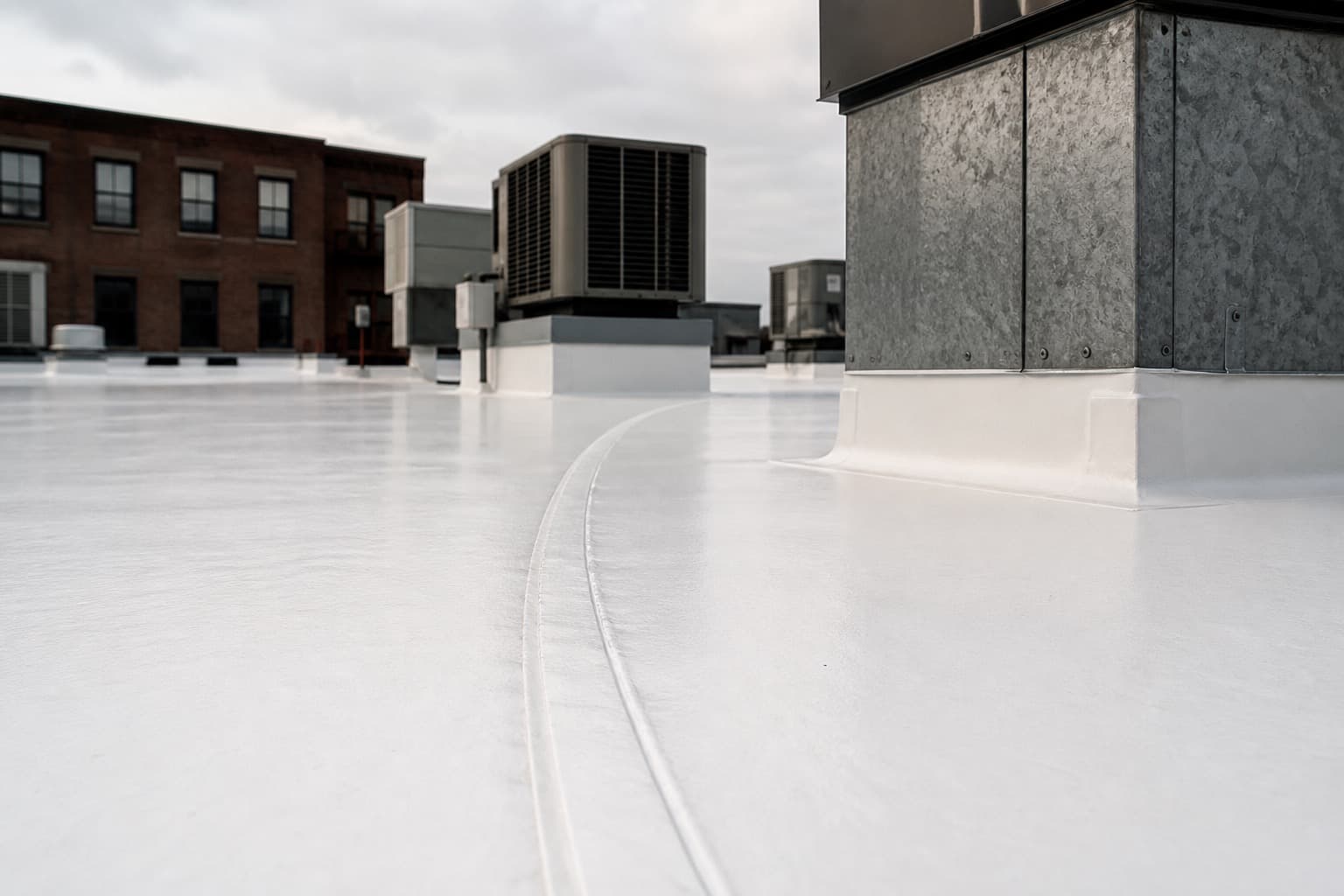
TPO — the modern default, done right at the seam.
Thermoplastic single-ply with heat-welded seams and a reflective surface. For most commercial buildings it’s the system that fits — and the seam is where the whole roof is won or lost.
Request a Roof WalkA single-ply membrane welded into one continuous surface.
TPO is a thermoplastic membrane rolled out in wide sheets across your deck, then fused seam-to-seam with a hot-air welder. Done correctly, a welded seam is as strong as the membrane itself — so instead of relying on tapes or adhesives to hold the sheets together, the roof becomes one continuous piece with no gaps for water to find.
It’s the most commonly specified commercial flat-roof system today, and for good reason: it pairs that welded-seam integrity with a reflective white surface that pushes cooling load down. For retail, office, warehouse, and most restaurants without heavy grease exhaust, it’s the system we reach for first — not because it’s what we most want to sell, but because it fits the widest range of buildings.
Three ways to attach it — chosen for your building.
How the membrane is fastened to the roof is a project decision, not a catalog default. We pick the method against your deck, your wind exposure, and your budget.
Mechanically Attached
Plates and fasteners hold the membrane to the deck. The fastest, most cost-competitive route — the common choice when the roof and wind exposure allow it.
Fully Adhered
The membrane is bonded to the substrate with adhesive for a smoother finished surface and stronger wind performance. Costs more, and earns it on exposed or high-uplift roofs.
Induction-Welded
Fasteners set into the insulation, with the membrane welded to the plate tops. You get mechanical-attachment speed with adhered-like wind resistance — a strong middle path.
Heat-Welded Seams
Whichever attachment we use, every seam is hot-air welded and probed for a complete bond. This is TPO's single most important quality checkpoint, and we photo-document it as we go.
What the numbers actually mean for you.
The spec sheet talks in mils and reflectivity ratings. Here’s what those translate to once the roof is on your building.
The modern default thickness — the balance of durability and value that fits most commercial roofs.
A thicker, tougher sheet for roofs that take foot traffic or need more puncture resistance and a longer warranty term.
Bounces sunlight instead of soaking it up, so your HVAC works less on hot days — and it meets cool-roof requirements under energy code.
No adhesive line to age out. The sheets become one membrane, so there are no gaps for water to work into over time.
Fewer, wider sheets mean fewer seams to weld and maintain across a large roof — and a faster, less disruptive install.
Independently rated reflective products are available when you need documented cool-roof compliance for code or utility programs.
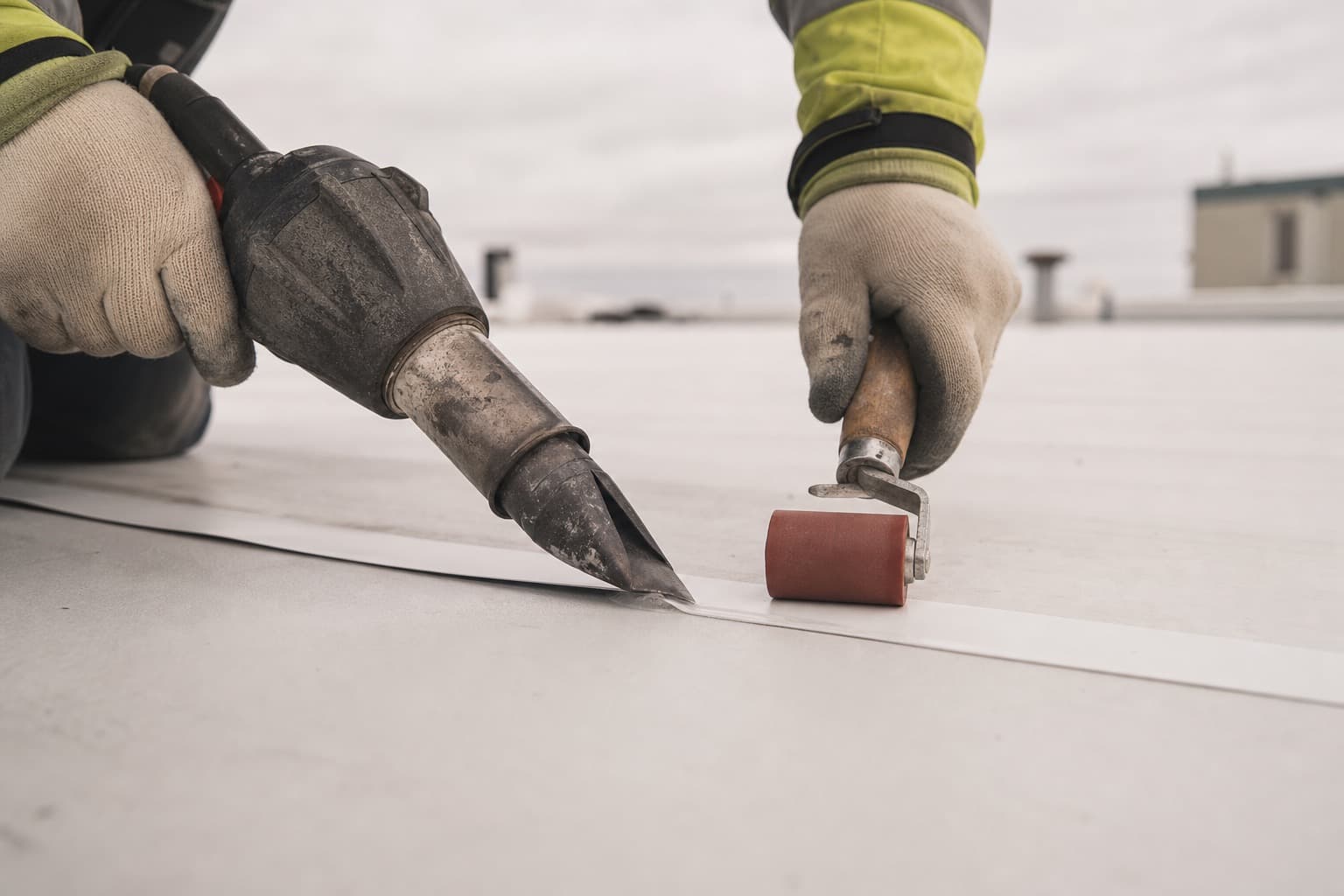
Most TPO failures start at a bad weld.
Cold-welds, under-welds, and skipped T-joints are the most common way a TPO roof lets water in — and they’re invisible from the parking lot. Our crews probe seams during install and photograph the work, so the part of the roof that decides its lifespan is the part we document most.
Why it earns the default position.
Welded-seam integrity
The strongest seam method in single-ply roofing — a continuous membrane rather than a field of taped joints.
Lower cooling load
The reflective surface keeps rooftop temperatures down, easing the demand on your HVAC through New England summers.
Fast, low-disruption install
Wide sheets and efficient attachment keep the tenant-impact window short — important on occupied buildings.
Competitive cost
For most applications TPO delivers most of PVC's install-and-warranty profile at a lower price per square foot.
Widely understood
Architects, consultants, and property managers all know it — an easy system to standardize across a portfolio.
Manufacturer-backed warranties
As a Carlisle Certified contractor, we can install certified TPO assemblies that carry manufacturer system warranties.
Where we’ll tell you TPO is the wrong tool.
No system is right for every roof. Here’s where we’ll steer you elsewhere rather than sell you TPO anyway.
Grease exhaust degrades it
Restaurant kitchen exhaust and other grease-laden air break TPO down over time. For grease-heavy roofs we route you to PVC for the affected zones.
Seam quality is installer-dependent
TPO is only as good as its welds. That's a reason to vet your contractor's QC — which is exactly why we probe and photo-document every seam.
The category carries old baggage
Early pre-2010 TPO formulations weathered poorly and shaped the category's reputation. Modern formulations resolved this, but it's worth knowing the history.
Very large simple spans
On big, uninterrupted flat expanses, EPDM's far wider sheets can mean fewer total seams — sometimes the better call for that specific roof.
The buildings TPO fits best.
Retail, office, and warehouse roofs where cool-roof reflectivity is a real operating benefit
Restaurants and mixed-use buildings without heavy grease exhaust at the roof
Re-roofs where you want a reflective surface and a manufacturer-backed system warranty
Buildings that need documented cool-roof compliance under energy code
Portfolios standardizing on one familiar, widely serviceable system across many buildings
When we’d point you to a different system.
Being consultative means naming the roofs where TPO isn’t the answer. These are the honest hand-offs.
The right material where grease or chemical exhaust hits the roof — restaurant kitchens and medical exhaust — where TPO would break down.
A deliberate choice on very large, simple flat spans where rubber's wide sheets, longevity, and easy repair carry the day.
When your existing roof is still sound, a restorative coating can extend its life and defer a full re-roof — no tear-off needed yet.
Two layers of protection, matched to the assembly.
Every TPO roof we install can carry two layers of coverage: a manufacturer-backed system warranty on the assembly, and the GEG workmanship warranty on our installation. The exact term depends on the assembly you choose — membrane thickness, attachment method, and manufacturer program all factor in — so we’ll lay out the specific options at your findings meeting rather than quote a number that may not apply to your roof.
Because we’re a Carlisle Certified contractor, we can install certified TPO assemblies that qualify for manufacturer system warranties. What that means for you in plain terms: two companies stand behind the finished roof.
Where we put TPO to work.
Retail & Shopping Plazas
The default for tenant-occupied plaza roofs — reflective, cost-effective, and standardizable across a portfolio.
Warehouses & Distribution
Wide, low-slope spans kept watertight and cool over inventory and dock operations.
Office & Medical Office
Clean, low-disruption re-roofs for office and outpatient buildings — with PVC reserved for chemical-exhaust zones.
Apartments & Condos
Reflective flat-roof coverage over occupied units, scheduled to keep disruption off your tenants.
Houses of Worship & Community
A budget-conscious, energy-saving roof for congregation and community buildings.
Property Management
One serviceable, familiar system to standardize across a mixed portfolio of buildings.
Let’s get on your roof and show you where it really stands.
A documented, no-obligation condition assessment — the honest starting point before any bid.