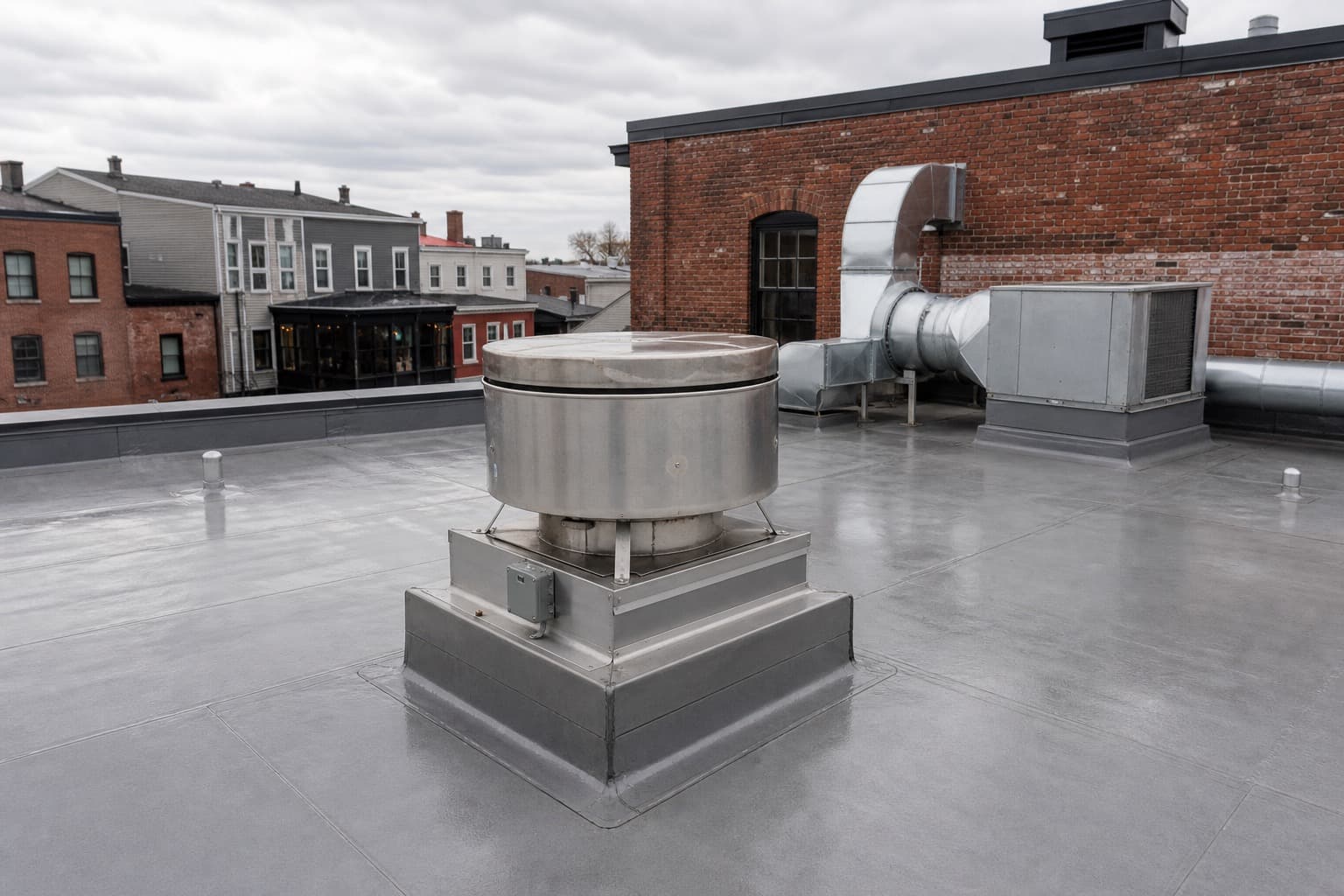
PVC — the right material where grease and chemicals hit the roof.
A heat-welded single-ply membrane with a property TPO doesn’t have: resistance to grease and chemical exposure. Over restaurant kitchen exhaust or medical exhaust, that resistance is the reason PVC exists on the roof.
Request a Roof WalkA welded membrane built to shrug off grease and chemicals.
PVC is a single-ply thermoplastic membrane with heat-welded seams, like TPO — but with a chemistry that resists grease, chemicals, and fire. That resistance isn’t a marketing angle; it’s a material property. Where a roof takes grease-laden exhaust from a commercial kitchen, or chemical exhaust from a lab or medical facility, PVC holds up in conditions that would degrade TPO or EPDM over time.
It’s also one of the longest-proven single-ply categories, used in commercial roofing since the late 1960s. We don’t position PVC as “better than TPO” in general — that would be inaccurate and it would sell you something you may not need. We position it as the correct material for a specific exposure profile: buildings where grease or chemicals reach the roof.
Welded like TPO, with the same seam discipline.
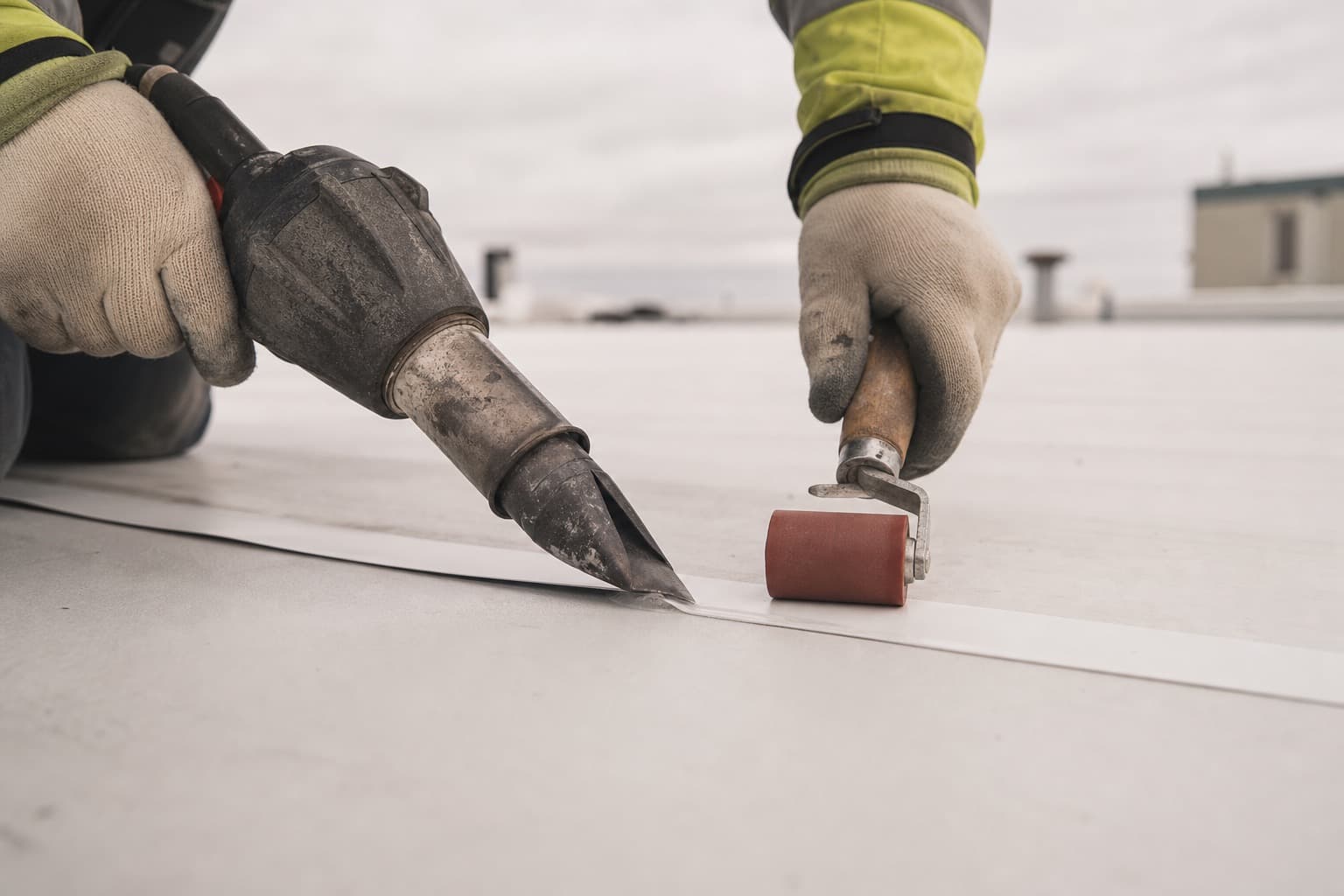
PVC uses the same family of attachment methods as TPO, and the same heat-welded seam — though PVC welding parameters differ, which is why crew experience with the material matters.
Mechanically Attached
Plates and fasteners hold the membrane to the deck — the fastest, most cost-competitive route where the roof allows it.
Fully Adhered
Bonded to the substrate with adhesive for a smoother surface and stronger wind performance on exposed roofs.
Induction-Welded
Fasteners set into insulation with the membrane welded to the plate tops — mechanical speed with adhered-like wind resistance.
Heat-Welded Seams
Seams are hot-air welded into one continuous membrane. PVC's weld window differs from TPO's, so getting it right depends on crews who know the material.
What the numbers actually mean for you.
The differences that matter with PVC are about exposure, not just thickness. Here’s the plain-terms read.
The single reason to choose PVC: it withstands kitchen-exhaust grease and chemical exposure that would break down other membranes.
A common default thickness — durable coverage for most PVC applications.
A tougher sheet for high-traffic roofs or where you want an extended warranty term.
PVC's chemistry is flame-retardant on its own — a meaningful trait on buildings where fire performance is scrutinized.
A polyester reinforcement layer keeps the membrane dimensionally stable, so it moves less with temperature swings.
The same continuous, no-gaps seam integrity as TPO — the sheets fuse into one membrane.
Where kitchen exhaust lands, PVC belongs.
Grease-laden exhaust is hard on a roof, and it’s exactly what PVC is formulated to resist. Often the smart move isn’t covering the whole building in PVC — it’s using PVC for the grease-impact zones around the exhaust and running a more cost-effective system elsewhere. We’ll map that on your roof during the walk.
What makes it the right tool for the job.
Grease & chemical resistance
The differentiator versus TPO — it handles restaurant grease exhaust and chemical exposure without accelerated breakdown.
Fire resistance
Flame-retardant by its own chemistry, which matters on buildings where fire performance is under scrutiny.
Welded-seam integrity
The same monolithic, no-gaps seam advantage as TPO — one continuous membrane rather than taped joints.
Long track record
The oldest single-ply category in continuous commercial use, with deep field-performance history.
Dimensional stability
Reinforced and low-movement, so it expands and contracts less through temperature swings.
Manufacturer-backed warranties
Certified PVC assemblies carry manufacturer system warranties, backed by the GEG workmanship warranty on our install.
The honest case against over-buying it.
PVC is the right answer for specific roofs, and the wrong one for plenty of others. We’ll be direct about which is which.
It carries a real cost premium
PVC costs more per square foot than TPO. That premium is justified by chemical exposure or warranty depth — not as a default. If your roof has no grease or chemicals, we'll tell you TPO does the job for less.
Not a general upgrade over TPO
PVC isn't 'better' than TPO across the board — it's better for a specific exposure profile. On a clean office or retail roof, the extra cost buys you nothing.
The category has legacy baggage
Older pre-1990s PVC formulations had plasticizer-migration issues. Modern formulations resolved this, but some owners remember the reputation — worth naming honestly.
It rewards crew experience
PVC's welding parameters differ from TPO's, and not every crew cross-trains cleanly. It's a system where who installs it genuinely matters.
The buildings PVC fits best.
Restaurants and commercial kitchens with grease exhaust reaching the roof
Medical, lab, and outpatient buildings with chemical exhaust or rooftop equipment
Food-production and industrial-kitchen facilities with chemical or grease exposure
Any roof where exposure is localized — PVC on the affected zones, a cost-effective system elsewhere
Owners who specifically require a premium single-ply system for warranty depth
When we’d point you to a different system.
If your building doesn’t have the exposure that justifies PVC, we’ll say so — and send you here.
When there's no grease or chemical exposure and cost matters, TPO delivers most of PVC's install-and-warranty profile for less.
On large, simple flat spans without chemical exposure, proven rubber with fewer seams can be the better fit.
When an existing single-ply roof is a life-extension candidate, a coating can defer a full re-roof.
Two layers of protection, matched to the assembly.
A PVC roof we install can carry two layers of coverage: a manufacturer-backed system warranty on the assembly, plus the GEG workmanship warranty on our installation. The exact term depends on the assembly you choose — membrane thickness, attachment method, and manufacturer program — so we’ll walk the specific options for your roof at the findings meeting rather than publish a number that may not apply.
Premium PVC systems carry some of the longest field-performance records in single-ply roofing, which is part of why owners with demanding exposure profiles spec them deliberately.
Where we put PVC to work.
Restaurants
The clearest use case — grease-resistant membrane over kitchen exhaust, installed around your service hours.
Office & Medical Office
The right material for medical and outpatient buildings with chemical exhaust or rooftop equipment.
Retail & Shopping Plazas
PVC for the food-service tenants in the plaza, with a cost-effective system over the rest.
Property Management
Targeted PVC on the grease- and chemical-exposed buildings in a mixed portfolio, matched building by building.
Let’s get on your roof and show you where it really stands.
A documented, no-obligation condition assessment — the honest starting point before any bid.