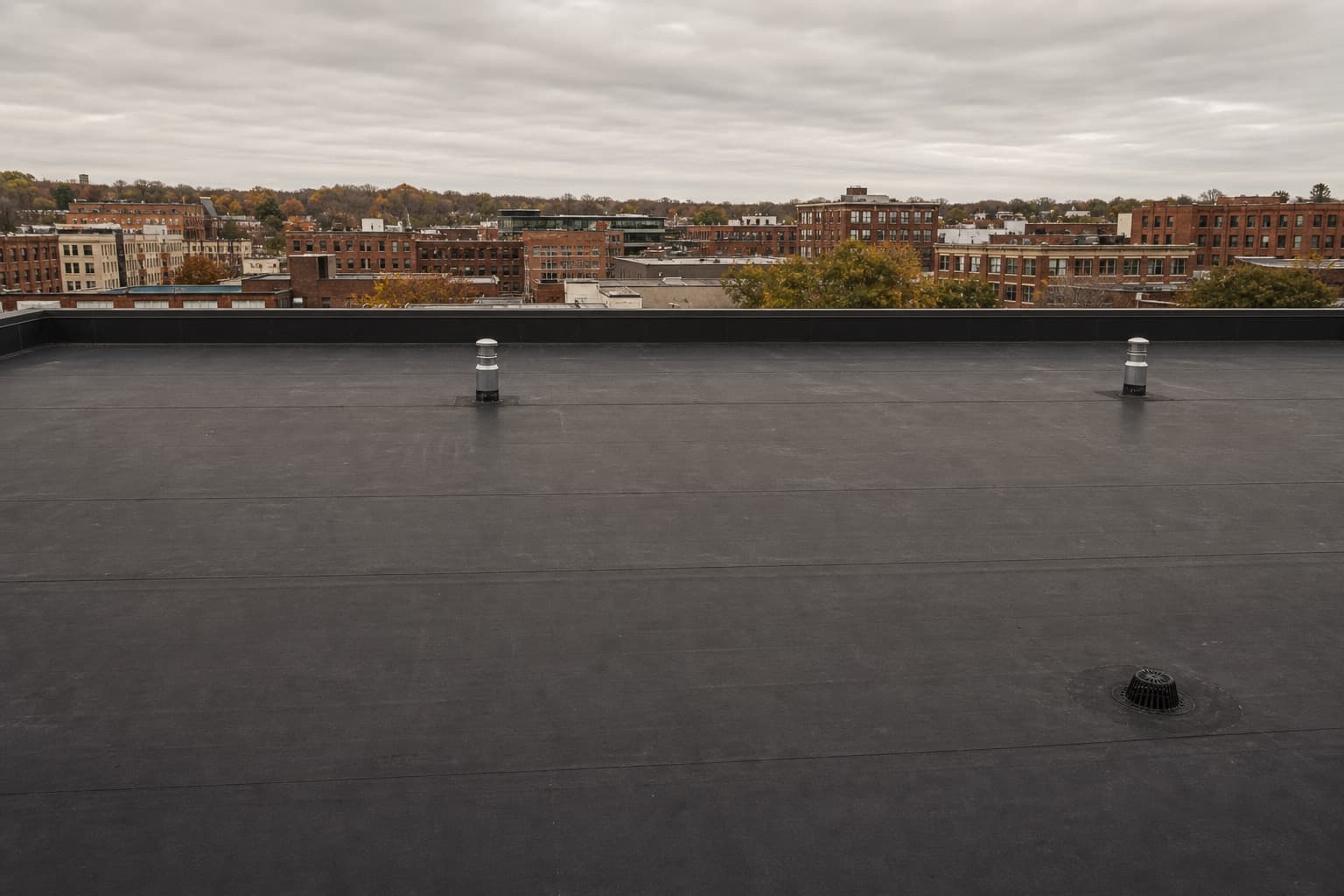
EPDM — the proven rubber roof for large, simple spans.
The longest-tracked single-ply system in commercial roofing, in continuous use since the 1960s. On big, uninterrupted flat expanses, its wide sheets and decades of field history make it a deliberate choice — not a fallback.
Request a Roof WalkSynthetic rubber, with the longest track record in the trade.
EPDM is a single-ply synthetic rubber membrane — the system with more field history than any other in commercial single-ply. Roofs installed in the 1970s are still in service, which means manufacturers, and you, are working with performance data measured in decades rather than marketing cycles.
It comes in very wide sheets, and that’s the whole story on a big roof: fewer sheets means dramatically fewer linear feet of seam to install and maintain over the life of the roof. Standard EPDM is black; a reflective white version is available where cool-roof performance matters. Choosing EPDM is usually a deliberate call for a specific building — not a default — and we’ll tell you honestly when that building is yours.
Three attachment methods, and a different seam story.
EPDM seams are bonded with splice tape or adhesive rather than heat-welded — a different approach than TPO or PVC, and one where prep and technique are everything.
Fully Adhered
Bonded to the substrate with adhesive. The most common method for new installs and re-roofs, with a clean finished surface and strong wind performance.
Mechanically Attached
Plates and fasteners at defined spacing. Faster to install and lower cost where the roof and wind exposure allow it.
Ballasted
Membrane loose-laid and held down by stone ballast or pavers. Rare on new work now, but still found on existing roofs we service and replace.
Bonded Seams
Seams are joined with splice tape or adhesive, not welded. Surface prep and installer technique are the make-or-break — which is where our documented QC earns its keep.
What the numbers actually mean for you.
EPDM’s advantages read as dry specs on paper. Here’s what they do for your building.
Far fewer seams across a large roof than TPO or PVC — and less total seam means less failure surface to watch over the years.
The modern default thickness for new installs — the durability most commercial roofs are looking for.
A heavier sheet where you want extra toughness and puncture resistance on a demanding roof.
Black is the proven standard; the reflective white version is there when cool-roof performance is the priority.
Warranty risk is well understood by manufacturers because the material has been on real roofs for half a century.
Stays flexible through New England winters without the cold-cracking concerns some other membranes carry.

On a big roof, seam count is the risk.
Every seam is a place a roof can eventually fail, so the fewer of them you have, the less there is to maintain. EPDM’s wide sheets can cut the linear feet of seam on a large span to a fraction of what a TPO roof of the same size would carry — and when a repair is needed, EPDM is one of the most forgiving membranes in the field to fix.
Why owners choose it on purpose.
Unmatched track record
No other single-ply system has the decades of real-world field-performance data EPDM has behind it.
Fewer seams on large roofs
Wide sheets mean far less total seam than TPO or PVC on the same square footage — less to install and less to maintain.
Winter flexibility
Performs reliably in cold climates, which matters for a roof that has to weather New England.
Easy, reliable repair
Field repairs on EPDM are well understood and dependable for the full life of the roof.
Good value at scale
Lower cost per square foot than PVC, and competitive with TPO once you're covering a large flat area.
Manufacturer-backed warranties
Certified EPDM assemblies carry manufacturer system warranties, backed by the GEG workmanship warranty on our install.
The honest trade-offs we’ll walk you through.
If another contractor pitched you TPO, you’ll have questions about EPDM. Here are the straight answers.
Black absorbs heat
Standard black EPDM soaks up sun and raises cooling load, and it won't meet most cool-roof requirements. White EPDM solves that — at a higher cost. We'll price both honestly.
Seams are bonded, not welded
Tape-and-adhesive seams depend on surface prep and installer technique rather than a heat weld. It works well when it's done right, which is a QC question worth asking.
Less common in new specs
Many architects default to TPO for the cool-roof benefit, so EPDM is usually a deliberate owner choice. That's not a knock — it just means it fits specific buildings, not every one.
Not a cool-roof default
If reflectivity is your priority and you're not specifically choosing rubber, TPO or white EPDM is the more direct route to cool-roof compliance.
The buildings EPDM fits best.
Large, simple flat expanses — warehouses, distribution, big-box retail — where fewer seams is a real advantage
Owners who prioritize proven longevity over modern-default reflectivity
Replacement-in-kind on an existing EPDM roof that has performed well
Cold-climate buildings where winter flexibility matters for the roof's lifespan
Roofs where easy, dependable field repair over the years is a priority
When we’d point you to a different system.
EPDM is a specific tool for specific roofs. Where it isn’t the fit, here’s where we’d send you.
When cool-roof reflectivity is a code or cost requirement and you're not specifically choosing black rubber, welded-seam TPO is the more direct answer.
When grease or chemical exposure hits the roof — restaurants, medical exhaust — you need PVC's resistance, which rubber doesn't offer.
When your existing EPDM is still in good shape, a coating can extend its service life and defer a full re-roof.
Two layers of protection, matched to the assembly.
An EPDM roof we install can carry two layers of coverage: a manufacturer-backed system warranty on the assembly, plus the GEG workmanship warranty on our installation. The exact term depends on the assembly — membrane thickness, attachment method, and the manufacturer program — so we’ll lay out the specific options for your roof at the findings meeting rather than publish a number that may not apply.
Because EPDM has a half-century of field history, manufacturers understand its warranty risk well — one reason certified rubber assemblies are among the more predictable systems to stand behind.
Where we put EPDM to work.
Warehouses & Distribution
Wide, uninterrupted low-slope spans where fewer seams is a genuine long-term advantage.
Apartments & Condos
Durable, easily repaired coverage over occupied residential units, scheduled around tenants.
Houses of Worship & Community
A proven, long-lived roof for congregation and community buildings watching their capital budget.
Retail & Shopping Plazas
A deliberate choice on large plaza roofs where seam count and easy repair matter more than reflectivity.
Property Management
A dependable, low-maintenance option across the large-span buildings in a mixed portfolio.
Let’s get on your roof and show you where it really stands.
A documented, no-obligation condition assessment — the honest starting point before any bid.