The system that fits the building — not the one we most want to sell.
We install every major commercial flat-roof system. Which one belongs on your building comes down to the roof’s condition, how the building is used, and where the cost needs to land on your plan. Here’s how each one earns the recommendation.
Request a Roof WalkSix systems, each right for a different roof.
A quick read on where each system fits. The detail — how it’s installed, its honest watch-outs, and the buildings it suits — lives on each system’s page.
Most retail, office, warehouse, and restaurants without heavy grease exhaust.
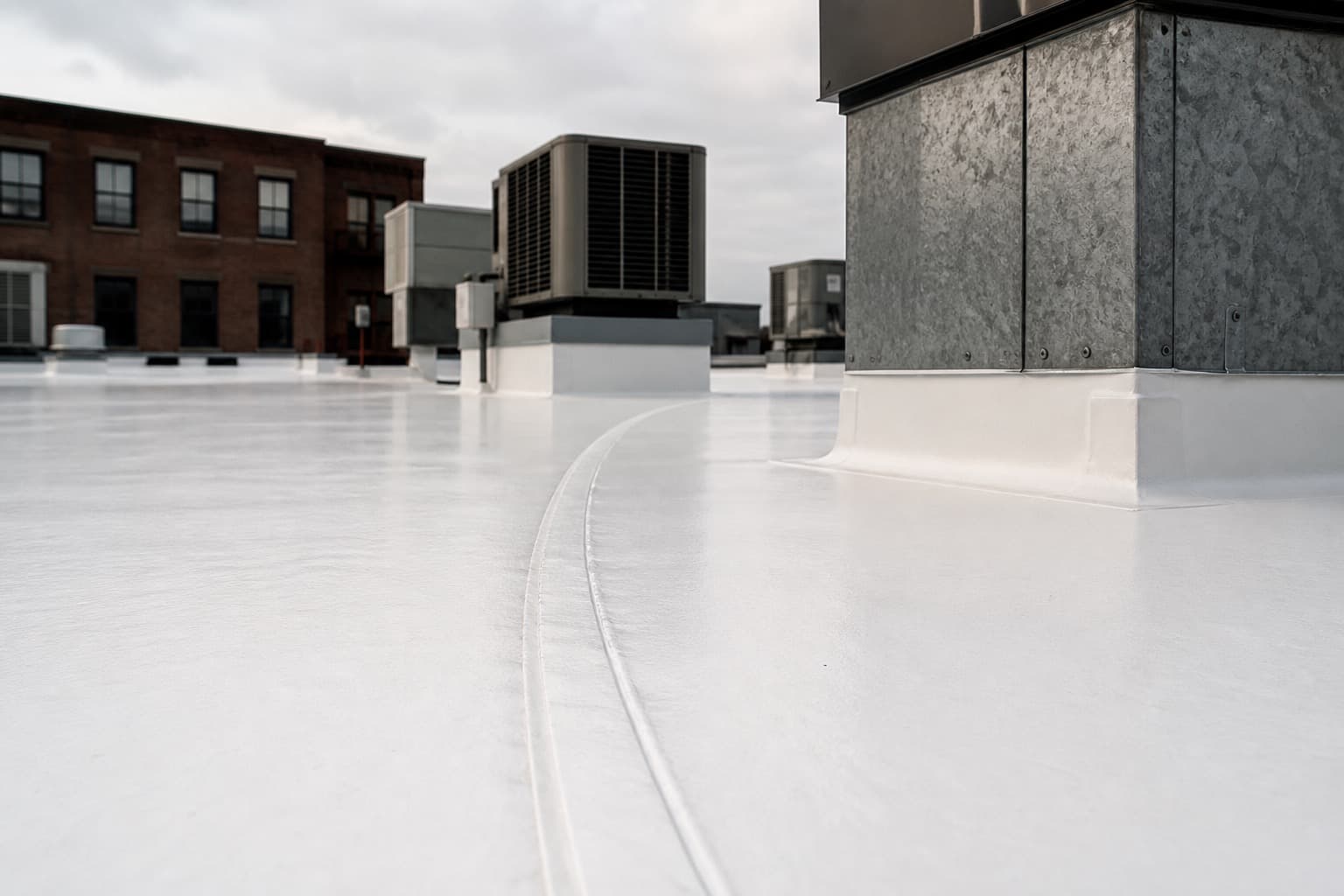
Heat-welded seams and a reflective cool-roof surface — the modern default.
Large, simple flat spans where fewer seams is a real advantage.
Proven rubber with the longest field track record and very wide sheets.
Restaurants and medical buildings with grease or chemical exhaust at the roof.
Welded seams plus grease and chemical resistance TPO doesn't have.
Sound roofs with real life left, where deferring a re-roof makes sense.
A restorative membrane over the existing roof — no tear-off.
Redundancy-first roofs and in-kind replacement of existing mod-bit.
Multi-ply asphalt, with self-adhered options that need no open flame.
In-kind replacement and heritage buildings expecting a traditional roof.
The classic multi-ply tar-and-gravel assembly — mostly replacement work today.
Three things decide the system — none of them is our sales target.
The right system falls out of the building, not out of a price sheet. We read these three before we ever name a material.
The roof itself
Its condition comes first. Whether the deck is sound, whether the insulation is dry, and how much service life is left decide whether you're repairing, coating, recovering, or replacing — before any material is chosen.
How the building is used
Grease exhaust points to PVC. A wide, simple span leans toward EPDM. A tenant-occupied building rules out open-flame methods. What happens under and on the roof narrows the field.
Your budget horizon
Repair, coating, recover, and full replacement sit in roughly ascending order of cost and lifespan. Where you need the roof to land on your capital plan is part of the recommendation — not an afterthought.
Explore each system in depth.
Every system gets an honest page: what it is, how it installs, where it wins, where it doesn’t, and when another system fits better.
Heat-welded seams and a reflective surface that cuts cooling load — the system that fits the widest range of buildings.
Explore TPOThe longest-tracked single-ply system, with wide sheets and fewer seams on large flat spans.
Explore EPDMThe right material where kitchen or chemical exhaust hits the roof — welded seams, plus resistance TPO lacks.
Explore PVCA restorative membrane that extends a sound roof and defers a full re-roof — when the roof qualifies.
Explore Roof CoatingsRedundancy-first asphalt roofing, with self-adhered options that need no open flame on occupied buildings.
Explore Modified BitumenWe keep the traditional multi-ply roof in our range so owners of older buildings have a contractor who still services and replaces it — recommended only where it’s genuinely the right answer.Learn more →
The system is the last decision, not the first.
We don’t start with a product. We start on your roof, and the right system falls out of what we find.
We walk your roof
Every seam, drain, flashing, and penetration — inspected on the roof, with a test cut when the assembly isn't clear. Nothing is bid from the parking lot.
We match use to material
What happens on and under the roof narrows the systems that actually fit. Exposure, span, traffic, and tenant impact all rule options in or out.
We price the options side by side
Repair, coat, recover, and replace — laid out together with the reasoning behind each, so you can see the trade-offs rather than a single number.
We recommend honestly
We tell you which system the building actually needs — not the one we'd most like to install. That posture is the whole point.
Let’s get on your roof and show you where it really stands.
A documented, no-obligation condition assessment — the honest starting point before any bid.