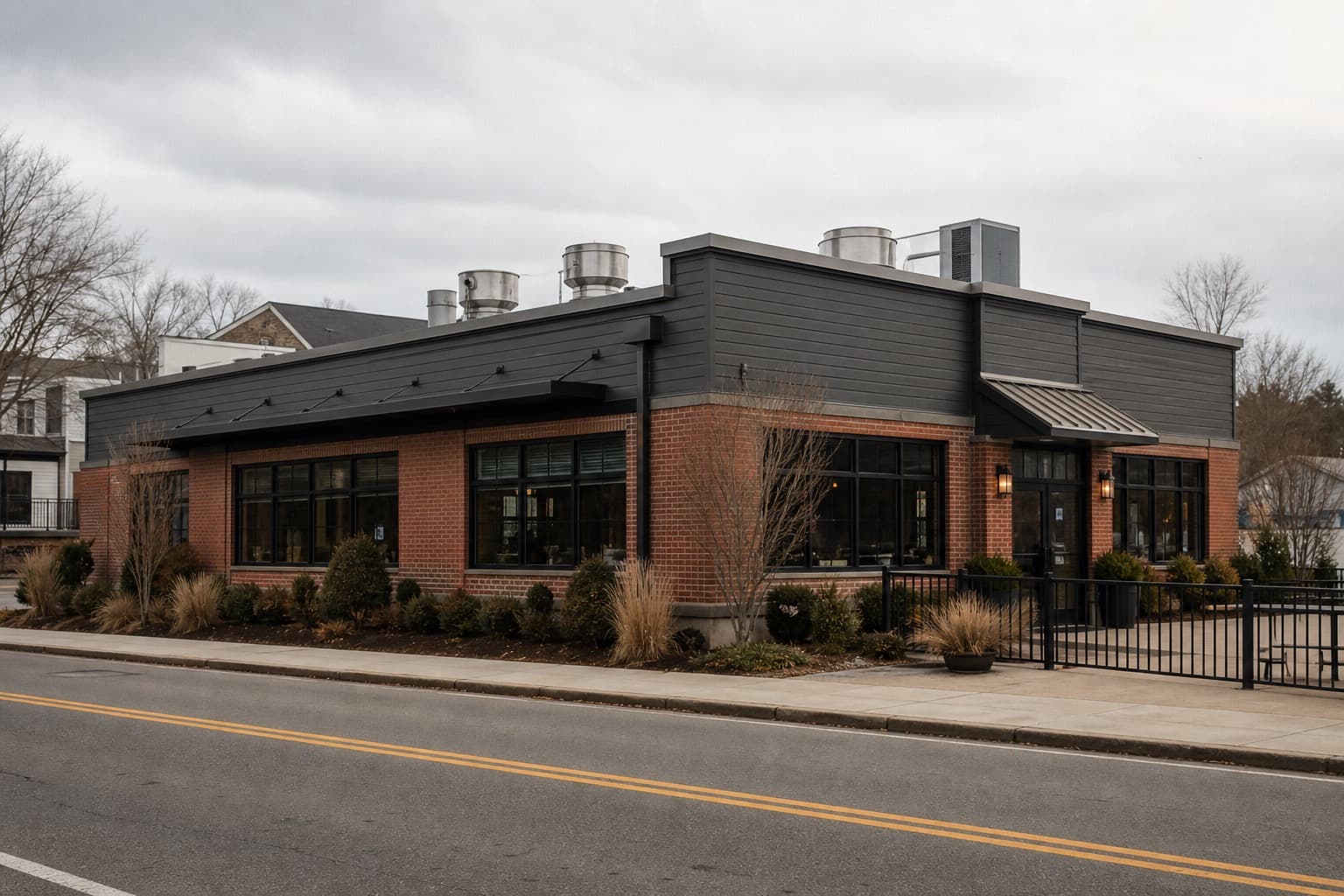
A roof built for grease, replaced without closing the kitchen.
Kitchen exhaust is hard on an ordinary roof, and every dark hour costs an operator money. We roof restaurants in grease-resistant systems and schedule the work outside service hours — so the membrane holds up and the kitchen stays open.
Request a Roof WalkA small roof, a hot kitchen, and no room for downtime.
Restaurant roofs are compact, crowded with equipment, and constantly bathed in grease-laden exhaust from the kitchen below. The two things that decide the job are the system that can take the grease and a schedule that keeps the kitchen serving.
- Freestanding restaurants and in-plaza units with flat or low-slope roofs over the kitchen line
- Kitchen exhaust fans venting hot grease-laden air directly onto the membrane around them
- Owner-operators and franchisees who lose money for every hour the kitchen is dark
- Rooftop equipment — hoods, make-up air, refrigeration — crowding a small roof footprint
What actually drives the restaurant roofing decision.
Grease is the roof-killer
Exhaust from the kitchen deposits grease that degrades ordinary membranes over time. The system over a kitchen has to be chosen for that, not in spite of it.
Every closed hour costs
A restaurant that can't serve is losing revenue in real time. The scheduling question isn't a nicety — it's the whole decision.
A crowded, working roof
Hoods, make-up air units, and refrigeration lines pack a small roof. Working around them cleanly, without cutting a line, takes care.
Health and safety don't pause
The kitchen below stays under health-code scrutiny. Debris, fumes, and open work are controlled so nothing compromises food service.
PVC is the system that stands up to a kitchen.
PVC membrane is grease- and chemical-resistant, which is exactly what the roof around a kitchen exhaust fan needs. Where ordinary membranes break down under constant grease exposure, PVC is engineered to hold — the reason it’s the standard call over restaurant kitchens.
The honest range — not an automatic tear-off.
You get repair, recover, and replace priced side by side, with the reasoning for each. If a targeted repair keeps you running another few seasons, that’s what we’ll tell you.
Roof Repair
Fast, targeted fixes to the grease-hardened seams and exhaust-fan curbs where restaurant roofs leak first.
Roof Recover
A new grease-resistant membrane over a sound deck — less disruption to service than a full tear-off when the roof qualifies.
Re-Roof & Tear-Off
When the roof is at end of life, a full rebuild in the right system — recommended only when the numbers justify it.
The questions every operator asks first.
- Can you work outside our service hours?
- Yes — off-hours scheduling is the norm on restaurant work, not the exception. The disruptive stages are staged for overnight, early-morning, or slow-day windows so the kitchen keeps serving. We build the sequence around your service calendar and confirm the plan before anyone gets on the roof.
- Will the kitchen have to close?
- In most cases, no. Membrane work happens above the kitchen, and we control fumes, debris, and open sections so service continues below. If a specific stage does require the line to be down, you know about it well ahead and it's scheduled for your slowest window.
- What about the exhaust and rooftop equipment?
- Hoods, make-up air units, and refrigeration lines are worked around carefully — flashed, sealed, and left running. Nothing gets cut or disconnected without coordinating it with you first.
Let's get on your roof between services and show you where it stands.
A documented, no-obligation condition assessment — scheduled around your kitchen, not the other way around.