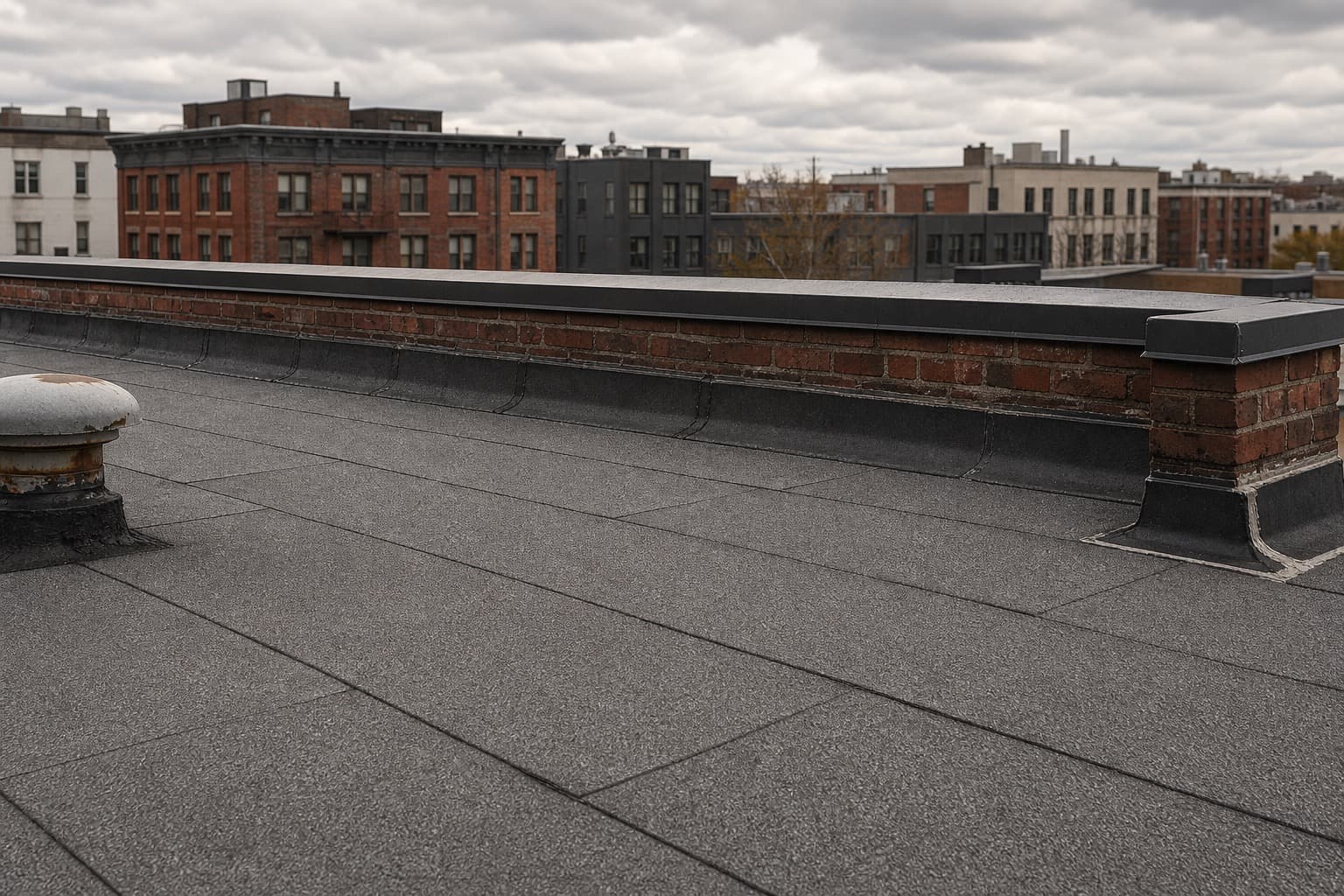
Modified bitumen — multi-ply redundancy, done predictably.
An asphalt-based membrane installed in multiple plies — the modern, factory-produced evolution of the traditional built-up roof. Where redundancy is the priority, or an existing mod-bit roof is due for replacement-in-kind, it’s often the straightforward answer.
Request a Roof WalkAsphalt roofing, evolved into a predictable sheet.
Modified bitumen is asphalt reinforced with polymer modifiers and produced as a factory-made sheet, then installed in multiple plies — typically a base sheet and a cap sheet. Think of it as the built-up roof’s more predictable descendant: the same multi-ply, redundant waterproofing, but manufactured to consistent specs rather than mopped up ply by ply on site.
Its defining trait is redundancy. Where a single-ply membrane gives you one line of defense, mod-bit gives you two or three. That makes it a deliberate choice for roofs where redundancy is the requirement — and the natural path when an existing mod-bit roof reaches end of life and the owner wants to stay in kind.
Four application methods — including no open flame.
How mod-bit goes down matters a great deal on an occupied building. The self-adhered option is why: it installs cold, with no torch.
Self-Adhered (SBS)
Peel-and-stick plies with factory-applied adhesive. Cold application, no open flame, fast install — the standout choice for occupied buildings and decks over living space.
Cold-Applied Adhesive
Plies bonded with an asphalt-based cold adhesive. No flame, with a slower cure — a safe route where hot work is restricted.
Torch-Applied (APP)
The cap sheet is melted to the base with an open-flame torch. Fast, but it carries hot-work fire risk and demands strict fire-watch protocols and the right substrate.
Hot-Mopped
The traditional method, with the cap embedded in hot bitumen. Rarely new-specified today, but part of the picture on legacy roofs we service.
What the assembly gives you.
A base sheet plus a cap sheet — two layers of waterproofing where single-ply gives you one. A 3-ply build adds redundancy where it's called for.
The common finish — it stands up to maintenance foot traffic and shrugs off UV better than a smooth single-ply surface.
The self-adhered SBS option installs cold, so there's no torch over an occupied building — a real comfort for tenants below.
Parapets, crickets, saddles, and irregular geometry are easier to detail cleanly in mod-bit than in single-ply.
Why mod-bit earns its place.
Multi-ply redundancy
Two or three plies of waterproofing beat a single membrane's one line of defense where redundancy is the goal.
Tolerates foot traffic
Granule-surfaced caps handle maintenance access and rooftop traffic better than smooth single-ply membranes.
No-flame option
Self-adhered SBS installs cold with no torch — the right answer for occupied buildings and decks over living space.
Strong on complex roofs
Complicated geometry and detailing — crickets, saddles, tie-ins — are more straightforward to execute in mod-bit.
Clean replacement-in-kind
When an existing mod-bit roof is at end of life, replacing it in kind is often the most direct path.
Manufacturer-backed warranties
Certified mod-bit assemblies carry manufacturer system warranties, backed by the GEG workmanship warranty on our install.
The trade-offs to know.
Torch methods carry fire risk
Torch-applied mod-bit is hot work — it needs permits, fire watches, and a substrate that can take it. We'll steer to a cold or self-adhered method where that risk isn't warranted.
It's heavier than single-ply
The added plies add weight, so structural load has to be verified before recovering an existing roof with mod-bit.
Shorter warranty terms
Mod-bit warranties typically don't reach the longest terms available on premium single-ply. Redundancy is the trade you're making for term length.
Different repair skill set
It's not heat-weldable — field repairs rely on adhesives or torch-down, a different discipline than single-ply repair.
The buildings mod-bit fits best.
Replacement-in-kind on an existing mod-bit roof the owner wants to stay with
Smaller commercial and mixed-use buildings
Decks and balconies over living space, where self-adhered SBS shines
Roofs with complex geometry where single-ply detailing gets expensive
Owners who specify multi-ply redundancy as a firm requirement
When another system fits better.
When longer warranty terms or cool-roof reflectivity are the priority, welded-seam TPO is the more direct answer.
On very large, simple flat spans, proven rubber with far fewer seams is often the better long-term choice.
When an existing mod-bit roof is still sound, a coating can extend its life and defer replacement.
Two layers of protection, matched to the assembly.
A modified-bitumen roof we install can carry two layers of coverage: a manufacturer-backed system warranty on the assembly, plus the GEG workmanship warranty on our installation. Terms depend on the assembly — ply count, cap finish, and manufacturer program — so we’ll walk the specific options for your roof at the findings meeting rather than publish a number that may not apply. Mod-bit’s strength is redundancy rather than the longest available term, and we’ll frame that trade-off honestly.
Where we put mod-bit to work.
Apartments & Condos
Self-adhered SBS over occupied units and decks over living space — no open flame above your tenants.
Office & Medical Office
Redundant, foot-traffic-tolerant coverage on smaller office and outpatient buildings with complex rooftop detail.
Houses of Worship & Community
A straightforward replacement-in-kind for older community buildings already roofed in mod-bit or built-up.
Property Management
The in-kind replacement path for the mod-bit and built-up roofs in a mixed portfolio.
Let’s get on your roof and show you where it really stands.
A documented, no-obligation condition assessment — the honest starting point before any bid.