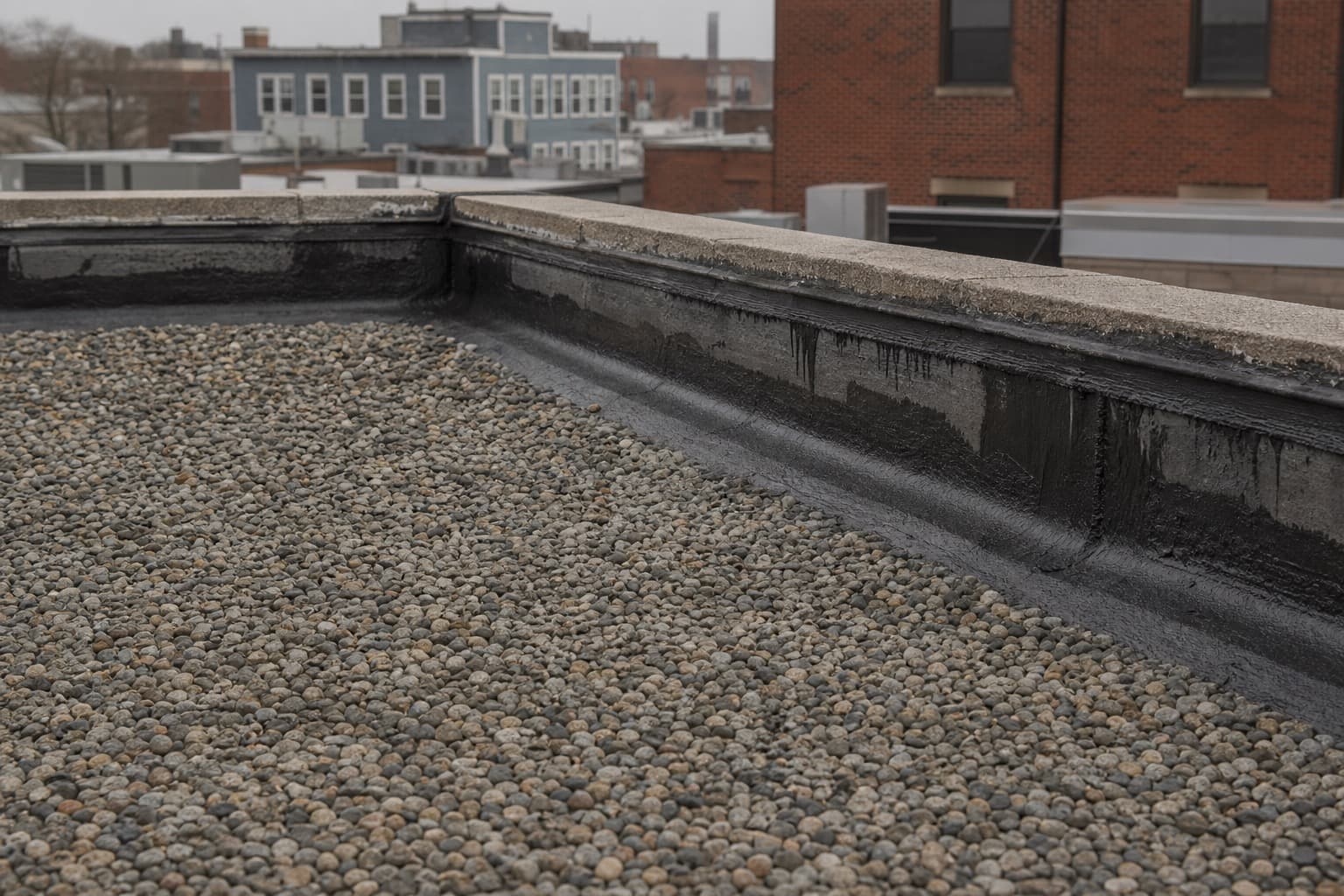
Built-up roofing — the traditional multi-ply roof, when it still fits.
The classic tar-and-gravel assembly — multiple plies of felt in hot bitumen, in continuous use for over a century. Most work today is replacement-in-kind, and we service and replace BUR where it’s genuinely the right answer.
Request a Roof WalkThe trade’s foundational roof.
Built-up roofing is the original commercial flat roof: three to five plies of roofing felt embedded in hot bitumen, topped with gravel ballast or a smooth surface coat. It has been in continuous use for more than a hundred years, and its multi-ply construction is still unmatched for sheer redundancy.
Most BUR work today is replacement-in-kind rather than new specification — single-ply systems have taken over most new commercial roofs. We keep BUR in our range so owners of older buildings have a contractor who hasn’t abandoned the category, and we’ll only recommend it where it’s truly the right call.
Hot bitumen, ply by ply.
BUR is hot work. Kettles heat the bitumen, and crews mop it between each layer of felt — which makes trained crews and strict hot-work protocols non-negotiable.
Hot Bitumen Plies
Three to five plies of felt are mopped into hot bitumen, building a thick, redundant waterproof assembly one layer at a time.
Gravel or Smooth Surface
Gravel ballast protects the membrane from UV and foot traffic; smooth-surfaced BUR is coated for UV resistance instead.
Cold-Process Option
Cold-applied adhesives replace hot bitumen where open-flame and kettle work are restricted — a route for sensitive or occupied buildings.
Controlled Hot Work
Kettles, hot-bitumen transport, and application are all controlled hot-work activities. We run them under strict permits, fire watches, and trained-crew protocols.
What BUR still does well.
Deep redundancy
Three to five plies of waterproofing is a level of redundancy no single-ply system matches.
A century of history
The longest-proven commercial roofing system, with performance understood over generations.
Handles heavy traffic
Gravel-surfaced BUR tolerates foot traffic, equipment staging, and routine access better than any single-ply.
Forgiving to repair
Plies can be patched without compromising the rest of the assembly.
Why it’s rarely the first choice today.
We’re candid about BUR’s limits — they’re the reason most new work goes to single-ply.
Hot-work safety demands
Kettles and open-flame adjacency require strict protocols and trained crews. It's manageable, but it's a real consideration on occupied sites.
It's heavy
The multi-ply assembly is heavy, so structural load has to be verified — it isn't an option on every older structure without reinforcement.
Odor and longer install
Asphalt fumes are noticeable and install windows run longer than single-ply. Occupied-building projects need careful coordination.
Declining installer base
Fewer crews still do new BUR at scale, and most current activity is replacement-in-kind. For most new roofs, a single-ply system is the better fit.
The narrow cases where BUR fits.
Replacement-in-kind on an existing BUR roof the owner wants to stay with
Heritage and institutional buildings where multi-ply gravel roofs are the expected long-term system
Roofs where multi-ply redundancy is a specific owner or consultant requirement
Roofs carrying very heavy foot traffic or equipment-staging demands
When another system is the better call.
For most new commercial work, we’ll point you toward a lighter, faster, longer-warranted system.
The modern default for most new commercial roofs — shorter install, lower weight, longer warranty terms, and cool-roof reflectivity.
When you want asphalt-based multi-ply redundancy but not a full traditional built-up roof, mod-bit is the more practical evolution.
When an existing built-up roof is still sound, a coating can extend its life and defer replacement.
Two layers of protection, matched to the assembly.
A built-up roof we install can carry a manufacturer-backed system warranty on the assembly, plus the GEG workmanship warranty on our installation. BUR is less aggressively warranted than modern single-ply, because the category has largely shifted toward replacement rather than new specification — but the systems installed today perform predictably. We’ll lay out the specific terms for your roof at the findings meeting rather than publish a number that may not apply.
Where BUR still comes up.
Houses of Worship & Community
Heritage and institutional buildings where a traditional multi-ply gravel roof is the expected long-term system.
Office & Medical Office
Replacement-in-kind on older office buildings already carrying a built-up roof.
Property Management
The in-kind replacement path for the legacy built-up roofs in an older portfolio.
Let’s get on your roof and show you where it really stands.
A documented, no-obligation condition assessment — the honest starting point before any bid.